


An energyrecycling process
The microbial loop is a network of very small organisms that play a major role in aquatic ecosystems. Bacteria use the dissolved organic matter in the water, small molecules originating from other organisms, to feed and multiply. Tiny unicellular organisms, such as protozoa and flagellates, then feed on these bacteria before being consumed by zooplankton. Fish then ingest these organisms, and the action of bacteria ultimately affects the entire food web, all the way to our plates. Thus, the microbial loop recovers and recirculates matter and energy that would otherwise be lost, reintegrating them into the food chain and making them accessible to larger marine organisms. Bacteria, which number in the millions in every drop of water, therefore directly support ocean health.
An important but often forgotten player: viruses
Viruses are the most abundant entities in marine environments, about ten times more numerous than the microorganisms they infect, but they are not always considered when discussing food webs. Viruses infect microorganisms such as bacteria and can lyse them, causing the host to burst. This process is very common; it is estimated that nearly onethird of all marine bacteria are killed by viruses every day. When this happens, the organic matter contained within the bacteria is released into the water in a dissolved form that is too small to be eaten by protozoa and flagellates, which are themselves consumed by zooplankton, then by fish. Viral infection produces organic matter that is too small to be consumed by anything other than microorganisms.
Viruses therefore modify the balance between marine microorganisms and the organisms higher up the food chain by controlling the quantity and type of matter available in the water.
When fjords warm, do the small organisms change too?
With climate warming, Arctic fjords are changing rapidly. Glacier melt can modify several environmental conditions, including temperature, light, and the amount of organic matter present in the water, as meltwater flows from glaciers into the ocean. Glaciers thus act as a conveyor belt between the terrestrial and marine worlds.
These changes can influence bacteria, viruses, and other small organisms that make up the microbial loop. If the quantity or type of available organic matter changes, this can affect the resources accessible to these organisms and the way organic matter circulates and is transformed within the ecosystem.
This can then ripple through the entire food web. For example, a change in microorganism abundance can influence the amount of food available for zooplankton, and then for the organisms that feed on it. This may have an impact on fisheries and on the communities that depend on fish for their food. The warming of fjords could therefore transform the circulation of organic matter within the ecosystem, with possible consequences for the entire Arctic food web.
Why this research matters
Microorganisms and the viruses that infect them are tiny, but their influence extends across the entire ecosystem. Understanding how microbial communities respond to climate change helps us better predict how Arctic food webs may transform. These changes may be felt at multiple levels, from microorganisms to fish and other marine animals. Better understanding these mechanisms therefore helps us anticipate the consequences of warming on Arctic ecosystems.
Aboard the FOREL
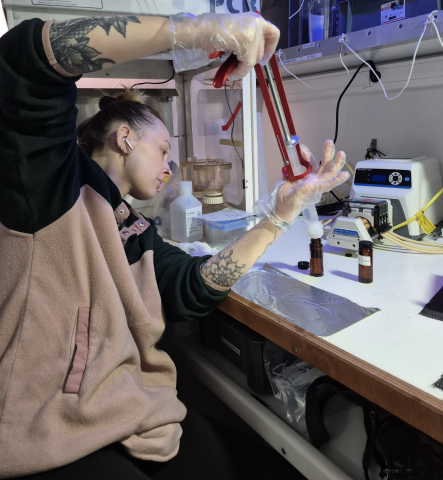
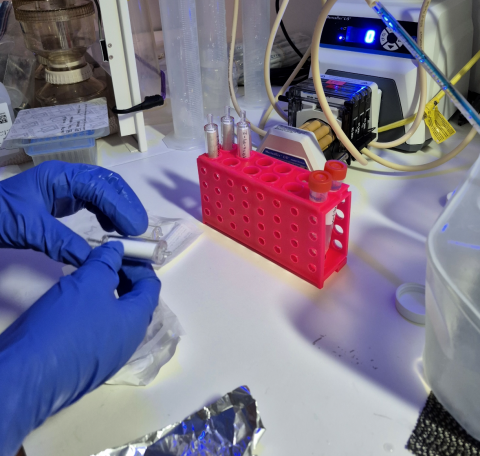
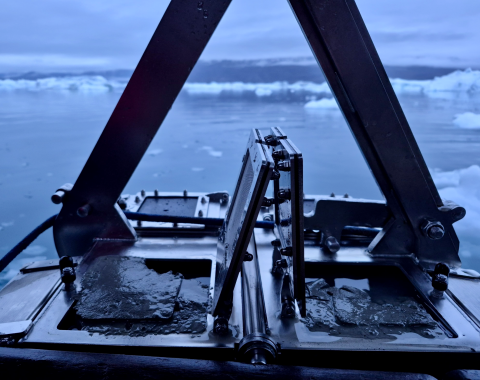
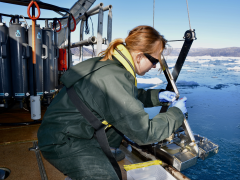
Aboard the FOREL, we collect water and sediment samples to measure the amount of organic matter present in the environment. These samples will also be used to study the microbial communities of different fjords through metagenomic sequencing.
This method consists of extracting and sequencing all the DNA present in a sample, then analyzing these sequences to identify the microorganisms present and the genes they carry. It provides a detailed portrait of the microscopic life in each fjord and helps us better understand the capabilities of these microorganisms and their role in the ecosystem.
To learn more