History
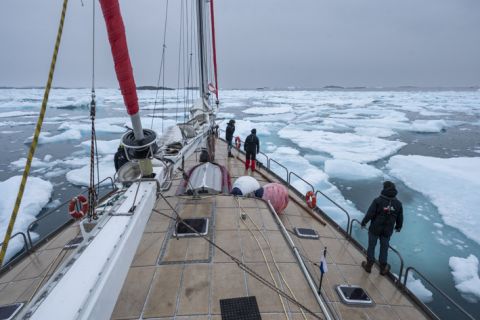
Before becoming the research vessel FOREL, the ship was known as Paratii II, a Brazilian expedition sailing vessel conceived for long-duration voyages in some of the most remote and challenging seas on Earth. Built in 2000, the 28-metre aluminum vessel was designed by the naval architecture firm Bouvet & Petit, in close collaboration with Amyr Klink and Thierry Stump. From the start, Paratii II was intended as a serious, ocean-going expedition vessel capable of operating autonomously in high-latitude and Southern Ocean conditions.
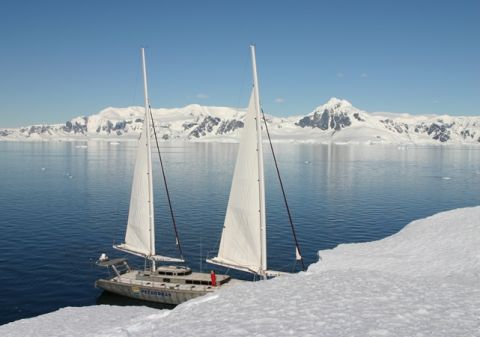
The design brief established by Amyr Klink was both visionary and unconventional for its time. Klink was inspired by centuries of empirical maritime knowledge and adapted it to a modern expedition yacht. Key concepts included excellent maneuverability, the use of ballestron masts, and a wide, shallow-draft hull. These choices ran completely counter to prevailing yacht design trends of the era, yet Klink’s insight and experience proved their validity on a “serious” offshore vessel for the first time. The hull form also allowed the boat to intentionally take the ground, a critical advantage for operations in remote polar and coastal environments.
Commissioned by Amyr Klink as the successor to his earlier boat Paratii, Paratii II embodied his philosophy of meticulous preparation, simplicity, robustness, and respect for the sea. Its aluminum construction, system redundancy, and structural strength made it particularly well suited to ice-affected waters, long ocean crossings, and extended periods without external support.
Over two decades with Klink at the helm, Paratii II completed numerous major expeditions, including repeated voyages to Antarctica, long Southern Ocean circumnavigation, and prolonged stays in isolated regions. The vessel served not only as a means of exploration, but also as a platform for observation, education, and storytelling, playing a central role in Amyr Klink’s books, lectures, and outreach activities that helped bring polar and ocean issues to a wider public.
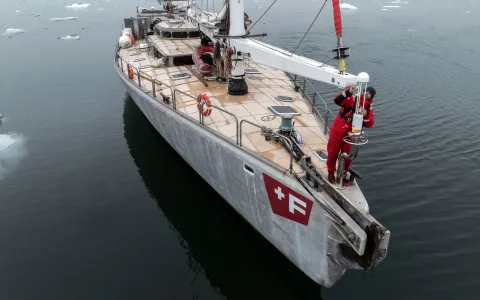
In 2022, the vessel entered a new chapter in its history when it was acquired by the Swiss Polar Foundation. In 2024, ownership was transferred to the Forel Héritage Association, definitively marking its conversion into a scientific vesselunder the name FOREL. After an extensive refit, it now supports multidisciplinary scientific missions in polar and sub-polar regions. While its mission has shifted from exploration to research, FOREL continues to rely heavily on the original design concepts defined by Amyr Klink, whose relevance and effectiveness remain evident in the vessel’s performance today.
Today, FOREL is equipped with state-of-the-art scientific instruments, including a CTD with rosette, a FerryBox system for continuous physicochemical measurements and water sampling, and a winch fitted with a cable enabling sampling operations down to 1,000 metres. Dedicated laboratory spaces (wet, dry, and clean) and work areas have been installed on board. Work surfaces, fume hoods, laminar flow units, Milli-Q water production, freezers, and chemical storage cabinets have been set up to accommodate additional equipment that scientists may install as part of the research projects conducted aboard the vessel.
Regarding future developments, it is planned to equip the winch with a power cable to further expand data acquisition capabilities. The cable is scheduled to be installed by the end of 2026 and to become operational in 2027.