




During the FOREL scientific expedition to Greenland, numerous research teams came together with a shared objective: to better understand the rapidly changing climate in the polar regions.
Today, we are pleased to give the floor to the Extreme Environments Research Laboratory (EERL) at EPFL, led by Professor Julia Schmale. From mid-June to July 2026, researcher Cecilie Litske Carstens joined the expedition aboard FOREL to investigate atmospheric aerosols and their role in the Arctic climate.
Tiny Aerosols, Major Impacts
Aerosols are microscopic solid or liquid particles suspended in the atmosphere. They originate from the ocean, land, biological and human activities. Although invisible to the naked eye, they play a crucial role in cloud formation, the Earth's radiation balance, and ultimately the global climate.
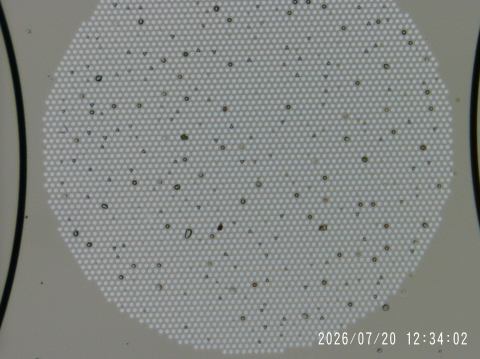
Aboard FOREL, the EERL team collected air samples in the Greenlandic fjords to analyze the size, number, chemical and biological composition of the aerosols present in these pristine environments. The measurements provide a unique "fingerprint" of the atmosphere, helping researchers to identify where these aerosols come from and how they are formed.
Cutting-Edge Technology to Explore the Infinitely Small Aerosols
To investigate the chemical composition of these aerosols, the researchers use an advanced analytical technique called Nano-Electro-Mechanical Systems Fourier Transform Infrared (NEMS-FTIR) spectroscopy.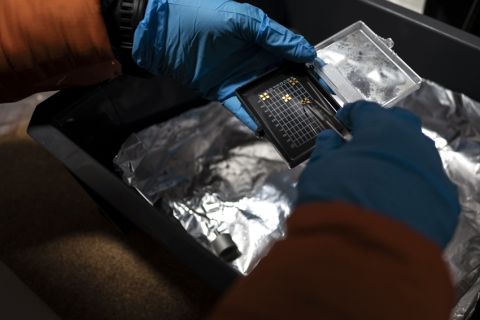
The aerosols are collected on tiny EMILIE chips, developed by Invisible-Light Labs. These highly sensitive sensors measure the infrared fingerprints of the collected aerosols. Ultimately, this allows scientists to identify the different types of aerosols present – even in the pristine Arctic atmosphere, where only small amounts of material are found.
One of the images captured during the expedition shows aerosols deposited on an EMILIE chip. The central area of the chip measures 600 micrometers in diameter, while each of the tiny circular structures is only 6 micrometers wide. For comparison, a human hair is approximately 50 to 180 micrometers in diameter, illustrating just how incredibly small these aerosols are.
Why Does This Research Matter?
The Arctic atmosphere is exceptionally clean during the summer. In such an environment, even very small changes in aerosol concentrations can influence cloud formation and alter the amount of solar energy reflected or absorbed by the Earth.
Because of this, the Arctic climate is impacted significantly by aerosols. By improving our understanding of their origin, composition, and interactions with clouds, the EERL team's research contributes to more accurate climate models and better predictions of future environmental changes.
Field Work at the Heart of Greenland's Fjords
Scientific expeditions aboard FOREL provide a unique opportunity for researchers to collect data in remote and rarely studied environments. These observations are essential for understanding the rapid transformations currently taking place across the Arctic.
Through collaborations between international research teams, data collected during the expedition will help advance our knowledge of polar environments and the Earth's changing climate.
We warmly thank Cecilie Litske Carstens and the entire Extreme Environments Research Laboratory (EERL) team at EPFL for sharing their work and contributing to this scientific mission.
Learn More
-
Extreme Environments Research Laboratory (EERL), EPFL
https://www.epfl.ch/labs/eerl/ -
Invisible-Light Labs – Discover the EMILIE chips used for aerosol analysis
https://invisible-light-labs.com -
Scientific publication – Nano-Electro-Mechanical Systems Fourier Transform Infrared (NEMS-FTIR) spectroscopy
https://www.science.org/doi/10.1126/sciadv.aeb2254