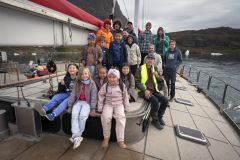



On September 13 and 14, this two-day event was organised in collaboration with the Narsaq International Research Station (NIRS), led by Lise Autogena. Over the two days, the boat became a space for discovery, exchange and learning, with guided visits, science and art workshops, as well as many opportunities to talk and connect with the people of Narsaq.
Beyond discovering the boat and the research carried out during the expedition, the main purpose of these days was to create a connection with the local community: to share our daily life on board, while also taking the time to listen, exchange and learn from those who live in this region of Greenland.
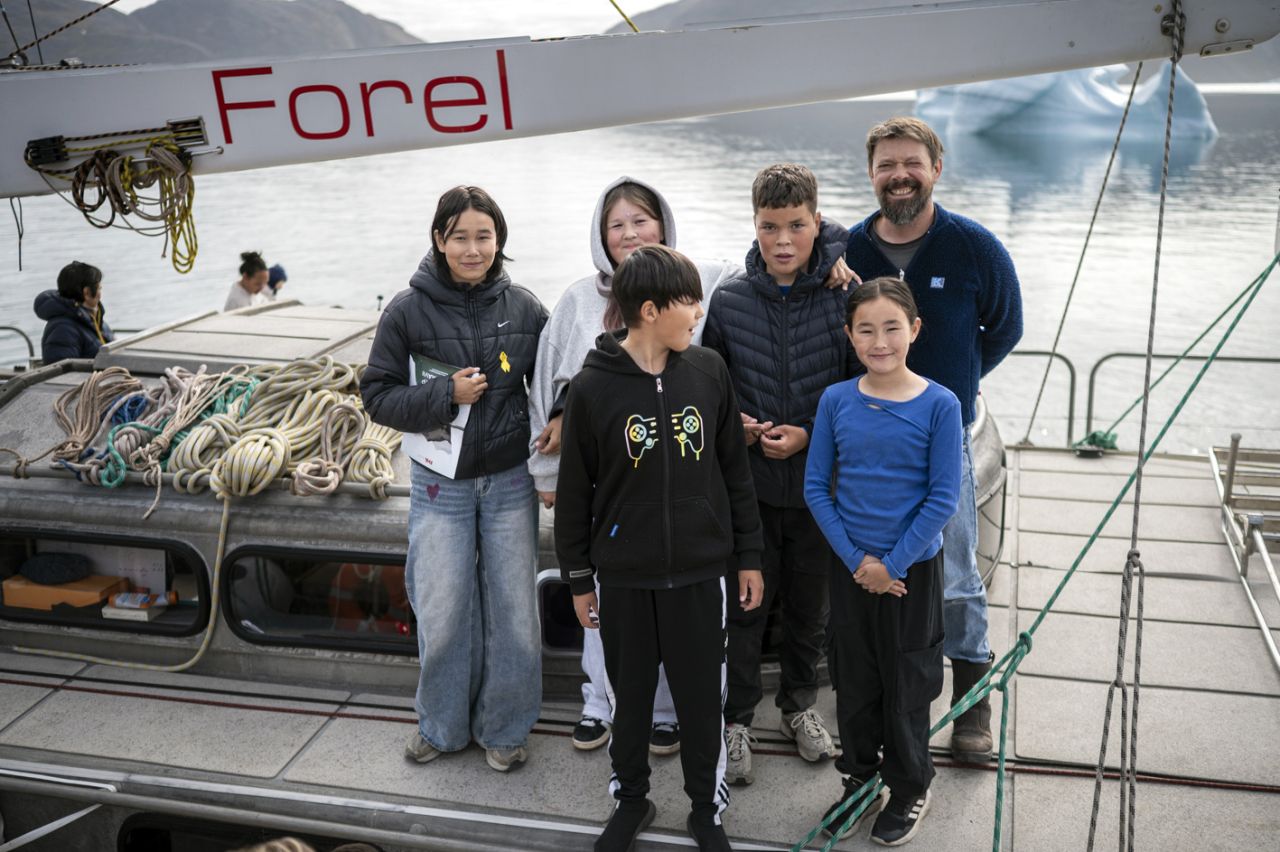
Sharing, connecting and learning from local communities
Since the beginning of the expedition, the Forel Heritage Association has been committed to building connections with the communities we meet along the way.
Welcoming people on board offers a chance to show what happens behind a scientific expedition: the laboratories, the equipment, the ongoing research, but also the everyday life of a crew spending several months at sea.
But these encounters are not only about sharing knowledge. They are also an opportunity to better understand the places we travel through and the people who live there, by taking the time to talk, listen and learn from their experiences.
The two days in Narsaq brought this approach to life in a particularly meaningful way.
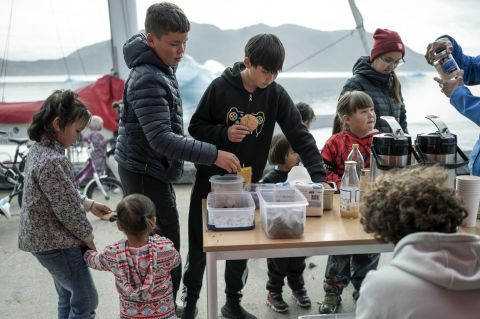
Nearly 250 people on board
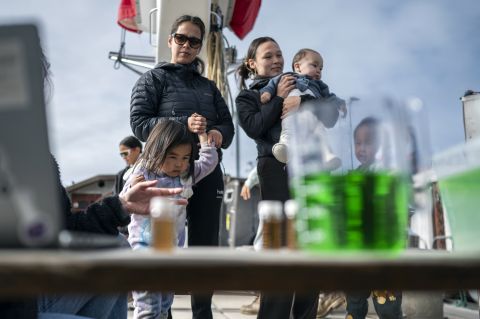
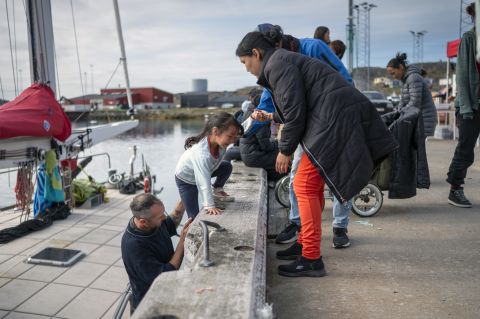
On Sunday afternoon, FOREL welcomed the general public on board. Families, adults and many children came to discover the boat and take part in the different workshops.
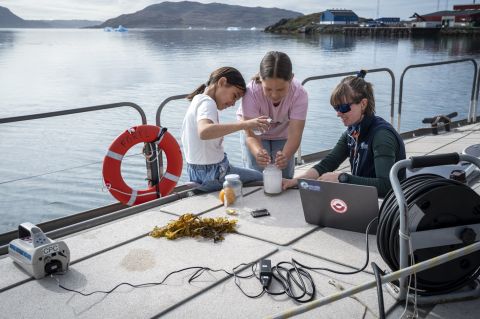
Around 100 people visited throughout the afternoon. Divided into groups, they were able to explore the vessel and its research spaces while taking part in science and art workshops.
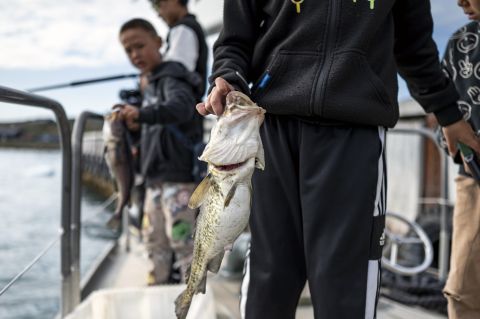
The children quickly made themselves at home on board. Their enthusiasm and curiosity brought the boat to life throughout the afternoon. Some even arrived with their fishing rods and ended the day at the bow of FOREL, trying their luck at catching cod.
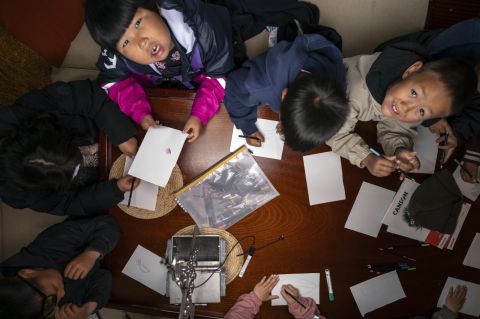
On Monday morning, several classes from Narsaq school came on board. Nearly 100 children, aged between 4 and 10, took part in the different workshops led by the scientists and crew.
The teachers also played an important role in facilitating the exchanges, helping with translation and encouraging the children to take part. Their presence was particularly valuable in a context where language could sometimes be a barrier.
In the afternoon, FOREL welcomed learners from Inuili – Food College Greenland. The exchanges took on a different form, with discussions focusing in particular on cooking and the organisation of meals on board.
In total, nearly 250 people came on board FOREL over the two days, each bringing their questions, curiosity and own perspective on our expedition.
Science as a way to build bridges
These two days would not have been possible without the commitment of the scientists on board, who devoted their time and energy to preparing and leading the workshops, despite the language barriers.
A special thank you to Indiana Bruzac, Juliette Le Hec and Lea Dorion Joannette, from Université Laval / Takuvik, and Cecilie Litske Carstens, from the Extreme Environments Research Laboratory (EERL) at EPFL.
Sharing science across different cultural and linguistic contexts can sometimes be a real challenge. Yet these two days once again showed us that curiosity, experimentation and the desire to share can build bridges, even when we do not speak the same language.
A final stop before the journey back to France
These Open Ship Days were also a special moment for FOREL: they marked the sailing vessel’s final mission in Greenland before beginning its journey back to France, after nearly four months of expedition.
There could hardly have been a more meaningful way to end this Greenland adventure than by dedicating these final days to meeting and connecting with the local community, before setting sail once again for the journey home.
We would like to warmly thank Lise Autogena and the NIRS for this wonderful collaboration, as well as the people of Narsaq for their warm welcome, enthusiasm and curiosity.
A heartfelt thank you also to the entire crew and to the scientists on board, who helped make these two days possible and turned FOREL into a true place for meeting, sharing and connecting.
Qujanaq Narsaq.
Photos : Julien Girardot