



Call for proposal 2027-2028 – Wintering in the Saguenay Fjord, Québec - Canada
About the FOREL Research Platform
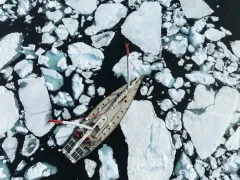
FOREL is a Swiss multidisciplinary oceanographic research sailboat (29 m in length, 2 m draft, aluminum hull), designed to minimize environmental impact through low-emission navigation and sustainable operational practices. She is equipped with three laboratories (wet, dry, and clean) as well as standard oceanographic instruments. Managed by the Forel Heritage Association, she is dedicated to research in polar and subpolar regions, particularly in coastal areas that are inaccessible to larger research vessels. As the number of berths is limited to six for scientists, teams are encouraged to coordinate and, whenever possible, pool their efforts.
See boat technical details
The Forel Heritage Association aims to support polar and subpolar coastal research, with a focus on the land–ocean–atmosphere continuum, while promoting the development and implementation of new technological approaches. Collaboration and engagement with local communities - particularly through outreach and the communication of scientific projects conducted onboard - as well as the training of early-career polar researchers, are also key priorities.
Specific information to note for the winter expedition in the Saguenay Fjord (2027-2028)
General context
The Saguenay Fjord, located at the heart of the Saguenay–St. Lawrence Marine Park, is a unique natural environment where highly productive marine and coastal ecosystems interact. During winter, the fjord is subject to particularly harsh conditions—including extensive ice cover, prolonged sub-zero temperatures, and strong winds—that profoundly alter its physical, chemical, and biological dynamics.
The winter deployment of the FOREL research platform in the Saguenay Fjord (winter 2027–2028) represents a unique opportunity to conduct field sampling during the winter season, a period that remains largely understudied, and to improve our understanding of the processes governing northern environments. The mission will also provide an opportunity to test new scientific protocols, methodologies, and equipment under real operational conditions. In addition, it will serve to validate the vessel's operational capabilities, as well as the associated logistical and technical procedures, before undertaking larger-scale missions in more remote northern regions, including the High Arctic. Finally, this project will help engage the scientific community, assess researchers' interest in using this type of research infrastructure during winter, and strengthen collaborations in northern research.
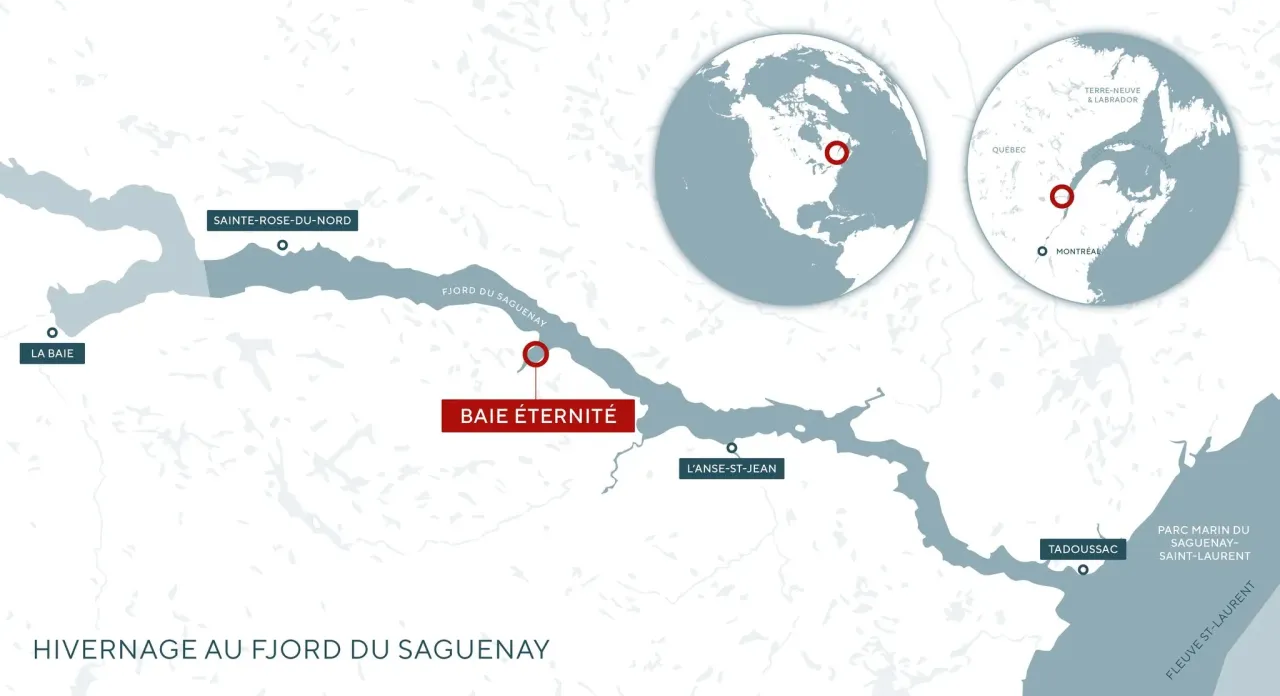
The preferred wintering location for the FOREL 2027–2028 expedition is Baie Éternité, located in the Saguenay Fjord (approximate coordinates: 48°18'18.62"N. 70°19'36.85"W). This proposed site has been selected by the Forel Heritage Association and the vessel's captains based on its operational suitability for the winter deployment. The location is currently subject to review and approval by the relevant organizations, local authorities, and private stakeholders. The approval process is expected to be completed by the end of beginning of next year.
Schedule and organization
The 2027–2028 winter expedition will be organized into three phases (legs):- Leg 1 – Freeze-in of the vessel (December 2027 – January 2028): Arrival at the study site and immobilization of the vessel in the ice, followed by the first sampling activities conducted from the ship.
- Leg 2 – Ice-covered period (January – February 2028): Sampling operations conducted from and around the vessel, with the possibility of extending field activities farther from the ship using snowmobiles.
- Leg 3 – Breakout from the ice (February – March 2028): Resumption of ship-based sampling until the vessel exits the ice.
Funding sources
- Swiss researchers may verify their eligibility with the Swiss National Science Foundation (SNSF)
Flat-rate and Daily fees
A flat-rate fee will be charged to researchers wishing to use the vessel during this winter mission.
The fees include accommodation on board, meals, and access to the vessel's scientific equipment, including deployment and recovery operations.
Depending on research needs and the proposed operational scenarios, it will also be possible to reserve the vessel for shorter periods of only a few days. In such cases, a daily rate may apply.
For more information on fees and participation arrangements, please contact the Forel Heritage Association by e-mail.
Social and educational dimensions
Beyond its scientific objectives, the expedition will foster stronger engagement with local and regional communities through:- Educational partnerships (e.g., the Fjord Museum)
- Knowledge mobilization activities benefiting local communities and the general public, including visits to the FOREL and science outreach events
Artistic dimensions
Artist residencies aboard the vessel may be considered during periods when scientific operations are less intensive, subject to the logistical and operational constraints of the expedition.
Target audience
Eligibility as Principal Investigator (PI) is limited to established researchers, postdoctoral fellows, and PhD candidates. The call for proposals is open to all researchers employed by an academic or governmental institution, or by a northern organization.
Researchers from all disciplines, including those considered “atypical” for polar sciences (e.g., engineering, materials science, medicine, social sciences and humanities, etc.), are encouraged to apply if they have a project to be conducted in a polar or subpolar context.
Environmental impact
To promote innovative and sustainable research methods, applicants are requested to adopt a thoughtful approach by assessing the merits of their project in relation to its environmental impact. The proposal should reflect efforts to incorporate innovative data and sample collection methods, optimized coordination and planning, strengthened collaboration with partners, and maximized sampling opportunities.
Submission
The complete application must be submitted as a single PDF file including:
- Application form (contact details, key information, project description, provisional budget)
- CV of the applicant and main partners, including a list of publications (mandatory – free format, maximum 4 pages per person)
The application deadline is January 15, 2027, at 12:00 (CET).
Interested applicants are invited to submit their complete application file by e-mail.
Evaluation
Eligible proposals submitted on time will be evaluated by an ad hoc Scientific Committee.
Projects will be assessed according to the following criteria:- Scientific/research merit of the proposed project
- Originality of the project
- Feasibility (scientific and logistical)
- Experience and expertise of the PI and partners for the proposed project
- Alignment with priorities to local communities
- Knowledge mobilization with local communities
- Contribution to the training of early-career polar researchers
Evaluation results will be communicated to applicants no later than February 15, 2026. Selected candidates will be contacted by the Forel Heritage Association to discuss the development of a mission plan.
Finalization of the mission plan
The final mission plan will be developed jointly with the principal investigators of the selected projects, in collaboration with the Forel Heritage Association and the vessel's captains. Only after this planning process has been completed will the expedition schedule, boarding arrangements, and the applicable flat-rate and daily fees be finalized and communicated to the principal investigators (PIs).
Consequently, the amounts requested by PIs from funding agencies to cover vessel time and operational costs may be adjusted upward or downward to reflect the final mission plan established following discussions with the participating researchers.
For any questions regarding the vessel or the expedition, please contact us by e-mail.