


Call for proposal 2027 - Mackenzie Delta (PAP-27); Northwest Passage
About the FOREL Research Platform
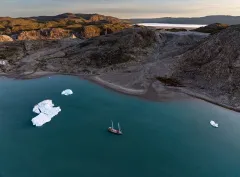
FOREL is a Swiss multidisciplinary oceanographic research sailboat (29 m in length, 2 m draft, aluminum hull), designed to minimize environmental impact through low-emission navigation and sustainable operational practices. She is equipped with three laboratories (wet, dry, and clean) as well as standard oceanographic instruments. Managed by the Forel Heritage Association, it is dedicated to research in polar and subpolar regions, particularly in coastal areas that are inaccessible to larger research vessels. As the number of berths is limited to six for scientists, teams are encouraged to coordinate and, whenever possible, pool their efforts.
See boat technical details
The Forel Heritage Association aims to support polar and subpolar coastal research, with a focus on the land–ocean–atmosphere continuum, while promoting the development and implementation of new technological approaches. Collaboration and engagement with local communities - particularly through outreach and the communication of scientific projects conducted onboard - as well as the training of early-career polar researchers, are also key priorities. In this context, we anticipate that at least one berth will be allocated to an Inuvialuit participant, either integrated within an existing research team or contributing through a dedicated project. This approach reflects the partnership’s broader commitment to meaningful Indigenous participation, capacity building, and the co-development of research activities in the Inuvialuit Settlement Region, while ensuring that each program aboard the vessel maximizes scientific and community value.
Specific information to note for the summer expedition in the Mackenzie River Delta region – Forel 2027
General context
The PAP-27 expeditions (Polarstern–Amundsen Partnership 2027) are a joint initiative supported by the Alfred Wegener Institute Helmholtz Centre for Polar and Marine research (AWI) and Amundsen Science, developed under the broader Arctic Pulse umbrella initiative, which aims to strengthen coordination, integration, and international alignment of Arctic research activities in the lead-up to International Polar Year (IPY) 2032-33. At its core, PAP-27 will investigate the physical, biogeochemical, ecological, and societal connectivity between the Beaufort Sea, the Canadian Arctic Archipelago, and adjacent coastal systems through coordinated international research platforms and Indigenous partnerships.
Complementing the offshore activities of the RV Polarstern and the CCGS Amundsen, the research sailboat Forel will operate in the coastal areas and shelf of the Mackenzie Delta, where none of the above icebreakers can operate due to shallow waters. The Mackenzie River Delta, located in northwestern Canada (Northwest Territories, NWT), is one of the largest Arctic deltas and plays a major role in exchanges between terrestrial, fluvial, marine, and atmospheric environments. This added capability will provide researchers with the opportunity to study this coastal zone characterized by intense exchanges between terrestrial and marine ecosystems.
The present call concerns the Mackenzie River Delta region, while a second call focuses on the Lancaster Sound (Nunavut, NU).
Schedule and organization
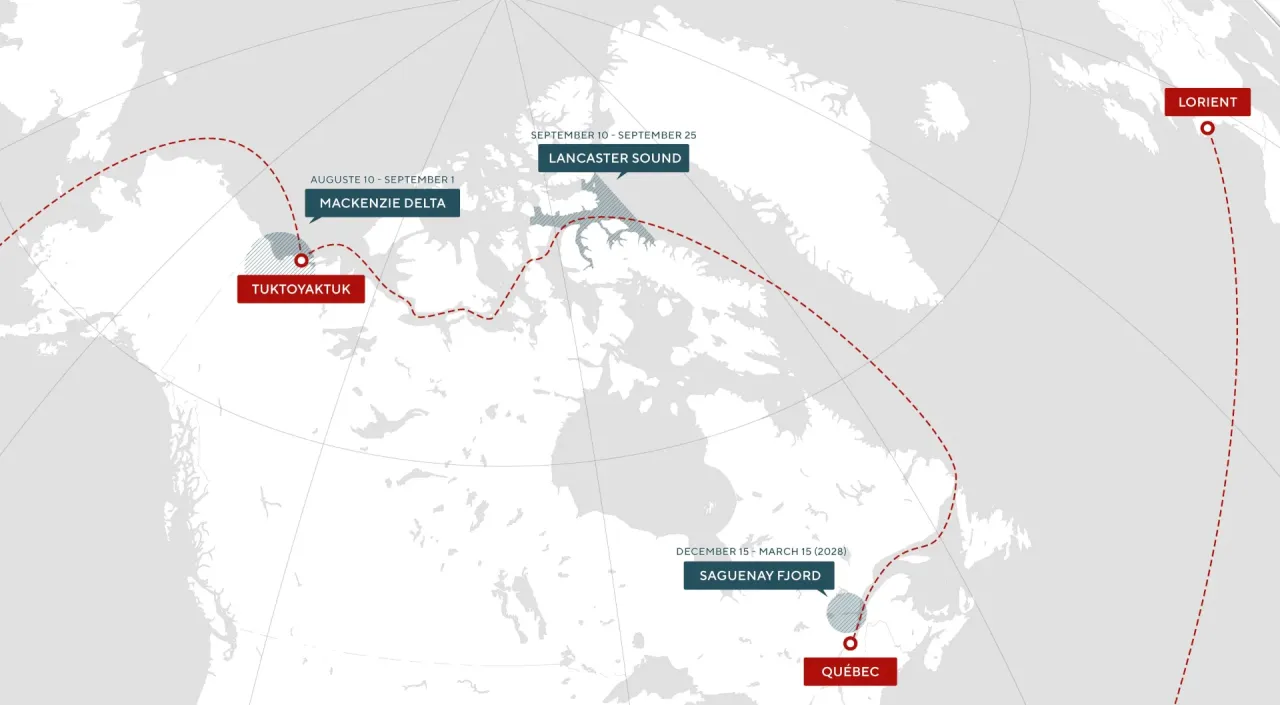
The 2027 summer expedition will be structured into five phases (legs):
- Leg 1 – Transit Lorient (France) – Pointe-à-Pitre (Guadeloupe, France): April to May
- Leg 2 – Transit Pointe-à-Pitre – Tuktoyaktuk (NWT): June to July
- Leg 3 – Tuktoyaktuk (PAP-27): mid-August to early September
- Leg 4 – Northwest Passage (Tuktoyaktuk – Pond Inlet, NU): September
- Leg 5 – Lancaster Sound: mid-September to late September (subject to a separate call for proposals)
Surface water sampling (primary production, elements, and particles) may be conducted during transit legs; this should be specified in the proposals.
Funding sources
Researchers affiliated with Swiss institutions may apply for funding through the Forel Heritage Association, for a maximum amount of CHF 50,000. Funding for ship time should be prioritized. Whenever possible, costs related to consumables and other logistical expenses should be covered through additional funding sources secured by the researcher.
- Swiss researchers may also check their eligibility with the Swiss National Science Foundation (SNSF).
Researchers affiliated with Canadian institutions or northern organizations may check their eligibility with the following organizations:
- Natural Sciences and Engineering Research Council of Canada (NSERC)
- Amundsen Science: Amundsen Science will support the participation of at least one Inuvialuit participant in the FOREL component of PAP-27. Priority will be given to applicants demonstrating strong interest in integrating land-ocean processes and capacity-building activities connected to the objectives of the expedition. Interested applicants are invited to contact Amundsen Science directly for further information regarding eligibility, support, and application.
Researchers affiliated with German institutions may obtain additional information about the German contribution to PAP-27, specifically the BeauPAIR program here:
- Alfred Wegener Institute and the BeauPAIR program by contacting the coordinators.
Per diem costs
CHF 1,000 per person per day. This rate includes onboard accommodation, meals, and the use of the vessel’s scientific equipment, including deployment operations.
Social and educational dimensions
Beyond the scientific aspects, the expedition will foster closer engagement with local and regional communities through:
- Educational partnerships
- Knowledge mobilization activities for the benefit of communities and the general public
Target audience
Eligibility as Principal Investigator (PI) is limited to established researchers, postdoctoral fellows, and PhD candidates, with the exception for Inuvialuit applicants as described below. The call for proposals is open to all researchers employed by an academic or governmental institution, or by a northern organization.
Inuvialuit participants are encouraged to apply, either as part of an existing research team or through the development of a dedicated project as PI. Participation pathways may be adapted to reflect the collaborative, capacity-building, and community-engaged nature of the initiative, while taking into account the limited berth capacity aboard the vessel.
Researchers from all disciplines, including those considered “atypical” for polar sciences (e.g., engineering, materials science, medicine, social sciences and humanities, etc.), are encouraged to apply if they have a project to be conducted in a polar or subpolar context.
Environmental impact
To promote innovative and sustainable research methods, applicants are encouraged to adopt a thoughtful approach by assessing the merits of their project in relation to its environmental impact. The proposal should reflect efforts to incorporate innovative data and sample collection methods, optimized coordination and planning, strengthened collaboration with partners, and maximized sampling opportunities.
Submission
A complete application file includes as a single PDF:
- Application form (contact details, key information, project description, provisional budget)
-
Supporting documents to be included:
- CV of the applicant and main partners, including a list of publications (mandatory – free format, maximum 4 pages per person)
The application deadline is September 1st, 2026, at 12:00 (CET).
Interested applicants are invited to submit their complete application file by e-mail.
Evaluation
Eligible proposals submitted on time will be evaluated by the Scientific Advisory Committee of the Forel Heritage Association and with representatives of the PAP-27 initiative.
Projects will be assessed according to the following criteria:- Scientific/research merit of the proposed project
- Originality of the project
- Feasibility (scientific and logistical)
- Experience and expertise of the PI and partners for the proposed project
- Alignment with priorities to communities in the Inuvialuit Settlement Region
- Knowledge mobilization with local communities
- Contribution to the training of early-career polar researchers
Evaluation results will be communicated to applicants no later than September 30, 2026. Selected candidates will be contacted by the Forel Heritage Association to discuss the development of a mission plan.
Finalization of the mission plan
The final mission plan will be developed with the leaders of the selected projects, in collaboration with the Forel Heritage Association and the ship’s captains. Only after this phase will the dates, boarding arrangements, and per diem amounts be specified and communicated to the PIs.
Consequently, the amounts requested by PIs from funding agencies for ship time may be adjusted—either increased or decreased—based on the final mission plan defined following discussions with the researchers.
For any questions regarding the vessel or expedition details, please contact us.
Map of the Summer Expedition – FOREL 2027